Cognitive Behavioural Therapy in The English and Welsh Criminal Justice System
In the 1800’s prisons across the world were seen as a place to dump criminals for life. There main aim was to harshly punish the individual with hard labour and poor living conditions. The severity of punishment was led in the United Kingdom (UK) by the notion that criminals inherited their ‘evil’ tendencies and could not change who they were. However, as we moved into the 20th century attitudes and psychological theories changed to include a more rehabilitative element (BBC Bite Size, 2025). This has been seen by the change in construction style and layout of the prison site by more modern institutions. The UK is even about to open its first ‘smart’ prison (gov.uk, 2022).
In the 1960’s a new method of therapy was introduced by two scientists Beck and Ellis called Cognitive Behavioural Therapy or CBT for short. Today, CBT has become the standard by which most rehabilitative interventions are set by within the English and Welsh prison and probations system (HMPPS) (Maguire et.al., 2010). But is CBT’s scientific efficacy robust enough for such use?
Where it all started
When Beck and Ellis designed this therapy they formed the Beck Institute which today is run by Becks daughter Alice. CBT is a psychoanalytic therapeutic technique that helps replace harmful thought processes with constructive ones that promote wellness within the whole person by changing the way we think about a problem. Its also known as a talking therapy due to the way the therapist and client interact thus discussing the issues the client would like to address (Klear Minds, 2025). Conditions that Beck and Ellis thought would benefit from this cognitive approach included anxiety, depression, panic attacks, obsessive thoughts and pain management (Beck Institute Cares, 2024). Since then CBT has become a bench mark for effective treatment. It is recognised as one of the most widely scientifically analysed therapies to date with Google Scholar returning over 1.5 million academic papers, books and articles (as of 01/04/2025).
How Does CBT Work?
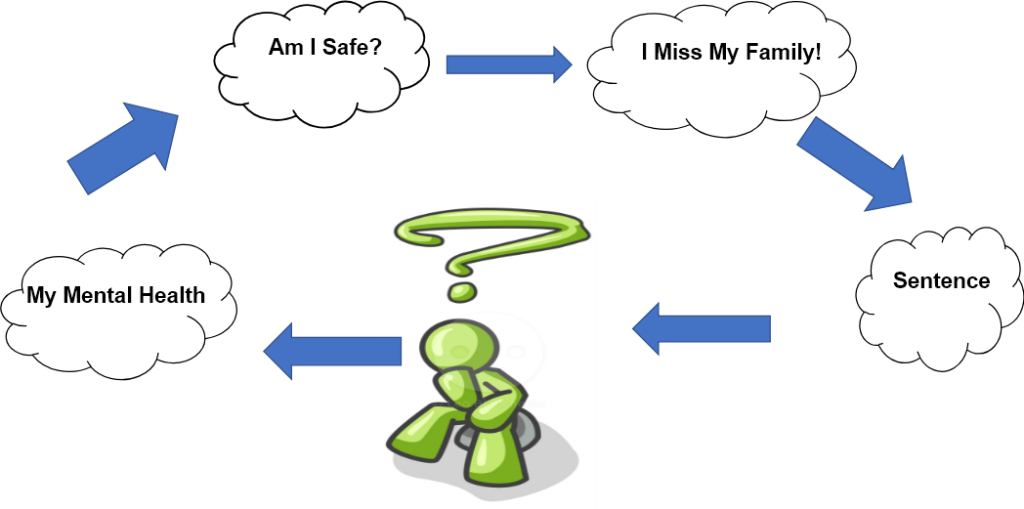
According to Branch & Wilson (2010) "applying CBT should feel like using good sense - that's because that's what it is based on - scientifically good sense. They explained that CBT was formed to assist the person to focus their attentions on the problems that they faced and then turn these issues into goals leaving you with a mentally reformed way of life. For example, all of us ruminate on stressors in our life as shown in the diagram below. However, CBT attempts to stop this process of continually looping or cycle, take out the bad intrusive ideas and replace them with new prosocial ones. CBT is one of the most highly researched topics in science and has been applied in therapy, criminal justice systems, addiction recovery, employment, trauma services to name just a few (Walton and Elliot, 2024).
Focus on custody and probation community settings
Cognitive Behavioural techniques have been applied within custodial settings since the 1980's in England and Wales and are now common place in all institutions the around the world. Some of the more recent programmes that are currently run within a large proportion of prisons in England and Wales include Horizon, iHorizon, Kaizen, Alcohol treatment programmes and domestic violence pathways.
Also, when supporting those who are suffering from suicidal thoughts and intentions, depression, obsessive ideas, panic attacks and more in-depth mental or behavioural illnesses - CBT is employed along with other options (EMDR, DBT, MFT etc.) to provide the appropriate care. Cognitive Behavioural Therapy (CBT) has become a cornerstone of rehabilitation within His Majesty’s Prison and Probation Service (HMPPS) across England and Wales. By targeting the thought patterns and behaviours that contribute to offending, CBT-based interventions aim both to reduce recidivism and to equip offenders with skills for healthier decision-making. Below, we explore how CBT is delivered, the evidence for its impact, and the key factors that shape its effectiveness:
Delivery of CBT in Prisons and Probation
Group and Individual Formats - Offenders are encouraged to participate in structured group programmes—such as the Thinking Skills Programme and Building Better Relationships—or receive one-to-one sessions tailored to issues like anger management, substance misuse, or trauma (Walton & Elliott, 2024). Group courses typically run over 10–20 sessions, while individual CBT is offered for those with particular clinical needs, such as depression or anxiety. All courses must be accredited before they are used across the justice system.
These accredited interventions based on CBT programmes must meet standards set out in the Correctional Services Accreditation Panel (CSAP). Facilitators receive specialized training, and session content is manualized to maintain consistency across sites. Integrated Case Management CBT is woven into broader risk management plans. Offenders’ risk and needs assessments determine whether CBT is delivered alongside vocational training, educational courses, or substance-use treatment, ensuring a holistic approach to rehabilitation.
Evidence for Effectiveness
According to a meta-analysis of three decades’ worth of quasi-experimental evaluations found that of the 37 papers examined, in general, CBT programmes delivered in English and Welsh prisons produced a small but statistically significant reduction in general reoffending (odds ratio = 0.91) (Yoon, Slade & Fazel, 2017). The authors noted that programmes implemented from 2006 to 2019 demonstrated consistent, modest gains in reducing recidivism, though effects varied with implementation quality.
Mental wellbeing of offenders increased too. Also, a paper that looked at a Systematic Review of Recidivism Outcomes - Smith et al. (2024) updated earlier reviews by synthesizing randomized controlled trials (RCTs) and well-matched comparison studies across youth and adult offender populations. They reported that high-integrity, theory-driven CBT interventions were associated with lower reoffending rates compared to usual probation or custodial practice, with effect sizes ranging from small to moderate.
There are numerous factors that may be influencing programme success across the English and Welsh prison and probation system. Three of these include:
· Implementation Fidelity Consistency in facilitator training, adherence to session manuals, and session dosage are critical. Walton and Elliott (2024) highlighted that variations in staff turnover, caseload pressure, and resource constraints can erode treatment integrity, diminishing CBT’s impact.
· Programme Adaptation Tailoring CBT to cultural backgrounds, literacy levels, and offence types improves engagement. For instance, adapting materials for young adult offenders or those with learning difficulties has been shown to enhance skills acquisition and application (Lowe & Pearson, 2010. & Billington, 2011).
· Integration with Supervision When probation officers reinforce CBT principles during routine supervision, offenders report better generalization of new thinking skills to real-world challenges (Lipsey et.al., 2007).
Challenges and Future Directions
Despite its central role, concerns persist regarding the diminishing effectiveness of some one-to-one CBT formats over time (e.g., for treating depression within offender populations). Researchers argue for:
· Ongoing Theory Refinement Revisiting CBT’s “mid-level” theoretical mechanisms—such as how offenders internalize responsibility—can inform programme enhancements.
· Mixed-Method Evaluation Combining quantitative recidivism data with qualitative feedback helps uncover how and why CBT succeeds—or fails—in particular settings.
· Digital Innovations Early pilots of online CBT modules show promise for extending reach into community supervision, especially where in-person sessions are limited.
With the Ministry of Justice being massively under funded for the past 17 years and the costs of running and facilitating courses let alone providing adequate staffing, food, heating, lighting, security etc., it is now more than ever to look at ways of either providing group therapies/courses or ways of reducing the length of courses yet still being able to be effective in reducing reoffending.
Conclusion
CBT remains a pivotal rehabilitative tool within the criminal justice system of England and Wales in particularly within HMPPS. Underpinning these accredited programmes in both custody and probation is a must. Its evidence base demonstrates modest but meaningful reductions in reoffending, contingent on faithful implementation and contextual adaptation within authorised programmes. As the criminal justice system in England and Wales in particularly within HMPPS. Underpinning these accredited programmes in both custody and probation is a must. Its evidence base demonstrates modest but meaningful reductions in reoffending, contingent on faithful implementation and contextual adaptation within authorised programmes. As the criminal justice system in England and Wales continues to embrace ongoing research and innovation, CBT is poised to evolve, offering more personalized and scalable interventions that support long-term desistance and a reduction in recidivism (repeating the crime).