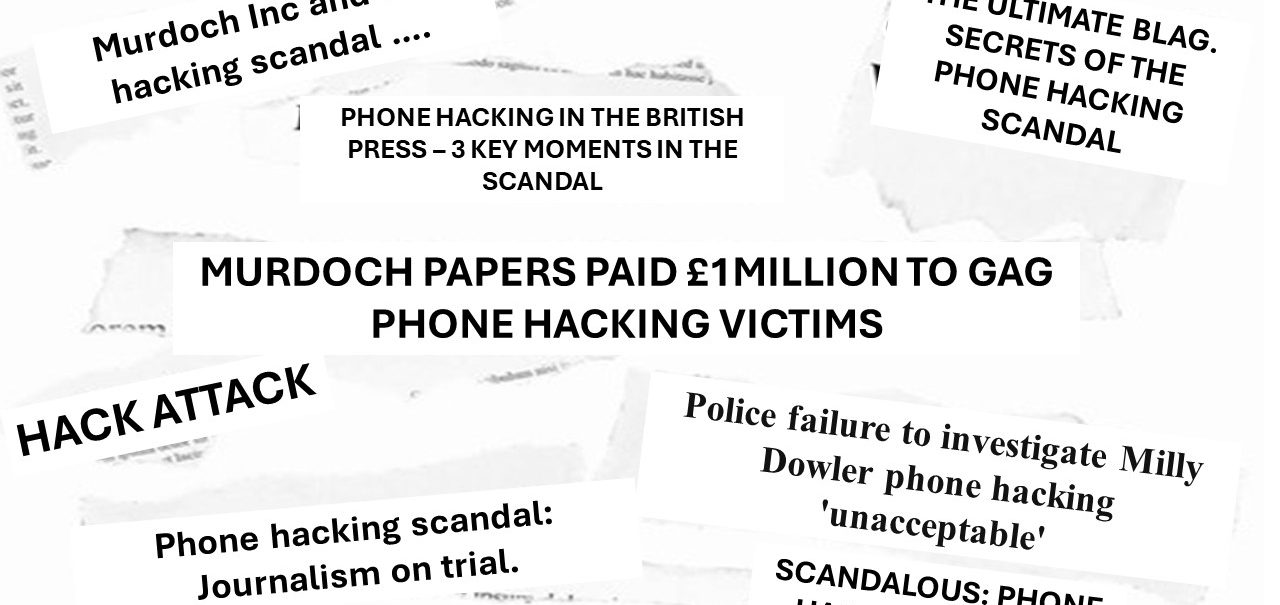
USING THE DARK SHADOWS TO CONCEAL DARK ARTS.
The News of the World Phone Hacking Crisis
What is a Narcissist? According to the American Psychiatric Association’s (APA) Diagnostic and Statistical Manual (DSM), a narcissist or an individual diagnosed with narcissistic personality disorder (NPD) is someone who exhibits extremely high self-assurance in all things, constantly demanding praise or approval from those all around them, has a feeling of entitlement and that nothing they could ever do would be wrong as that only happens to others who are viewed lower than them in all respects. They can become extremely violent and aggressive if there chosen few do not constantly adore them. In personal or sexual relationships this can lead to domestic violence, rape, assaults or even death (APA, 2013, p.767 &768). Narcissism is considered a part of what psychologists call the ‘dark triad’ or ‘triangle’.
So, what has this got to do with our article on the phone hacking scandal? As we go through this article why don’t you compare what happened to the victims of this so-called dark art and the people who perpetrated these crimes.

Background
What does it mean to ‘hack’ someone’s electronic device? “To hack or to employ the method of hacking”, the Oxford English Learners Dictionary (2025) explains is “an aggressive or violent approach to removing or to break-in” to someone’s electronic data “without the owner’s consent”. In July 2011 the world witnessed one of the most dramatic media events to unfold in world history – the closure of the News of the World (NoW), a British tabloid newspaper that had been in print for 168 years. According to the Encyclopaedia Brittanica (2025), some will remember this news title for exposing celebrity and political individual’s sexual relationships and scandal, hard hitting narratives and worldwide sports. In the end, scandal over its reporters and senior editors use of phone hacking and blagging led to its downfall. Although the NoW owners, News Corp, have never legally acknowledged this.
The scandal surrounding private investigators being hired by journalists and editors, from a number of newspapers, employing known illegal phone hacking not only shook journalism as a whole but also exposed deeper problems across the British and American press including whether to regulate this industry in the UK. This article will explore the ongoing phone hacking scandal, how it took an extremely brave few to investigate and reveal those involved within News Corp, which is part of the Murdoch empire, along with other newspaper corporations such as The Mirror Group, why there was an important need to inform the public, how some were held legally accountable and how it uncovered a limited amount of alleged corruption within British politics, The Metropolitan Police (The Met) – the UK’s largest police force, and the Crown Prosecution Service (CPS). We will delve through the material using a psychological lens and employ key concepts such as: dynamics of power, group behaviour or group think and moral disengagement.
News of the Word and News Corp
Rupert Murdoch, the worldwide owner and most senior director of News Corp was born in Melbourne, Australia in March 1931. He has built one of the largest media conglomerates in history crossing numerous country boundaries across the expanse of the world. Some of his local, national and international media companies include:
- Fox News Channel
- Fox Business Network
- Fox Broadcasting Company (Fox TV)
- Fox Sports (FS1, FS2, Fox Deportes, Big Ten Network)
- Tubi (streaming service)
- TMZ (online tabloid site)
- Fox Television Stations (a group of nearly thirty local TV stations across the U.S.)
- Fox One (new streaming service launched in 2025)
- Penske Entertainment (parent of the IndyCar Series and Indianapolis Motor Speedway)
- 20th and 21st century fox
- vertical video company Holywater
- The Wall Street Journal
- New York Post
- Dow Jones & Company (publisher of Barron's, MarketWatch, Dow Jones Newswires, Factiva)
- HarperCollins (book publisher with imprints including 4th Estate, Collins, Harlequin, Thomas Nelson, Zondervan)
- News UK & News Corp (publisher of The Sun and The Times / The Sunday Times)
- News Corp Australia (publisher of The Australian, The Daily Telegraph, Herald Sun, The Courier Mail, and numerous local and community newspapers and magazines such as Vogue Australia, GQ Australia, delicious., body+soul)
- TalkTV, Talkradio, talkSPORT, Times Radio, and various Irish radio stations)
- Australian News Channel (operator of Sky News Australia)
- Sky TV (BskyB) including Sky Sports
- Numerous other local news outlets online and print.
- REA Group (operator of realestate.com.au in Australia and other international property sites)
- Move, Inc.
- Realtor.com
- Hipages Group
- Foxtel
- DAZN
- Storyful
- Various other digital properties and marketing services
As you can see from the company names above, this massive concentration of media power has given the Murdoch family considerable influence and control on the way societies around the world function (Podemski, 2011). Rupert Murdoch purchased The Sun and News of the World (NoW) newspapers in 1969 and had subsequently transported them to the biggest circulation newspaper not just in Britain but across the globe. This lasted for NoW until its closure in 2011by News Corp and for The Sun until 2018.
The Scandal Unfolds
The need to be first to publish a news story or scoop the best and dirtiest celebrity gossip has always been the difference between great or terrible sales in the media business. However, from early the 2000s, and some say as early as the 1960’s, it became apparent that ‘following one’s gut or nose’ was not enough for some papers (Davies, 2014 & 2025, p.76-79 & 85). Some journalists at various British and American newspapers including News of the World engaged in a plan to get headline news and celebrity gossip at any cost to maximise profits. By 2015, there was evidence to prove that 30 of Murdoch’s journalists – 27 at NoW and 3 at The Sun had employed these ‘dark arts’ (Davies, 2014 & 2025, p.26). There was suspicion that tens if not hundreds more journalists across the British and American press were engaging PI’s, if not engaging in phone hacking themselves, to obtain their headlines illegally. Nick Davies a freelancing journalist who also writes for the newspaper The Guardian, discovered that he had evidence of at least 23 journalists that worked for 2 of the News Corp newspapers that had hacked or hired PI's to blag information on victims in an illegal manner (Davies, 2014 & 2015)
One method that was employed included hiring private investigators (PI’s) to illegally “blag” information from companies such as mobile phone operators, BT, energy companies, government departments such as Department of Work and Pensions (DWP) and DVLA etc (Johnson, 2012 & Hurst, 2016, p.36). Also, another prominent method of obtaining information was through another criminal process of “phone hacking”. One of the most shocking revelations to come out over these scandals was the hacking of British murdered schoolgirl’s mobile phones – that of Milly Dowler (2002), Jessica Chapman and Holly Wells (2002) (Davies, 2025, p.335-360). Although thousands of other people had been victims of this scheme, it was the hacking of these young schoolgirls phones which sparked massive public outrage and additional pain to their families and friends (Stanyer, 2015, p.99-108). The scandal revealed systemic use of these ‘dark arts’ across British journalism, including bribery of police officers, government ministers, civil servants & industry regulators (Mair, 2013 & Johnson, 2012).
Morally Disengaged?
Albert Bandura a famous American psychologist and scientist explained how human's tend to justify unethical behaviour by minimizing any harm or diffusing their responsibility (Bandura, 1999). To illustrate, one way being morally disengaged may play out is when a member of the public becomes ill and requires assistance but people do not go to their aid thinking that it is the responsibility of others to do so. To illustrate this point further, let’s go back to 1964 America. An American women named Catherine (Kitty) Genovese lived in New York and was working as a bar maid and waitress when she was savagely raped and murdered by Winston Mosley on her way home from work one night. Although there were allegedly numerous opportunities for bystanders and local residents to assist no one came to her aid (Manning & Levine, 2011).
How does Kitty’s murder in 1964 link with this article? Newspaper executives and reporters rationalized in a similar way utilising the same psychological principles as all those witnesses of Kitties rape and murder back then in 1964 that it was not their responsibility. Court transcripts, research papers and subsequent books on the phone hacking scandal have revealed that hacking was considered “just part of the job” (Usher, 2016 / Di Salvo & Polezza, 2020). This distanced them from their victims’ pain and suffering. Another example of this attitude can be seen with the corruption links between The Metropolitian Police in London, UK and NoW journalists. A rape survivor who was sexually assaulted by 2 well known male actors on her way home discovered that her police statements were written in The Sun and NoW newspapers word for word alongside her name - not just once but twice. Senior executives and reporters at the former News of the World newspaper and The Sun thought absolutely nothing at committing alleged perjury in court, before a British Parliamentary committee and the official Leveson inquiry when questioned about their involvement and knowledge of these illegal activities (Davies, 2025 & Leveson, 2012). Even when Rupert Murdoch and his son James were asked questions under oath, they claimed that they knew nothing of what their senior management team were doing (Davies, 2025, p.356 - 360).
Some victims expressed that they were intimidated or were racially or homophobically discriminated and slandered by senior figures in NoW and The Sun when they supported the revelations coming out (Colbran, 2022). Even those that had questioned them or had written articles allegedly exposing their crimes. have published that they were threatened, followed and had their phones hacked too (such as Nick Davies, Alan Rushbridger, Tom Watson MP etc.).
Power Dynamics - running a tight ship!
Understanding power dynamics is fundamental to navigating any system, whether it’s a small team or a global organization” (The sustainability directory (2025). At its core, power dynamics can refer to the way influence and control are distributed throughout society or corporations and then exercised among individuals or groups. It’s not simply about who holds a formal any position of authority; it’s a complex interplay of factors that shape various interactions and decisions. These factors can include formal authority, access to resources, social status, expertise, and even an individual’s personality traits. This explanation is important because it shows that power is not always visible or obvious, and it can shift depending on the context.
A clear description of power dynamics involves recognizing that these relationships are rarely static. They can change over time as circumstances shift, individuals gain or lose influence, and the overall environment evolves.
Power dynamics between the British press and politics as well as societies members (you and I) may not always seem obvious or even toxic. The media proport to reveal the truths that can be hidden by those in power to empower individual people in society. However, when the press starts to manipulate decisions that they would perceive to be a threat to their power, function or financial stability then this power balance or dynamic shifts into toxicity. News Corp used its power dynamics to position itself into strength over any other organisation in the media business.
Over the years, it has been revealed that Rupert and James Murdoch would drop hints or summon very senior British politicians and even royals to ‘lunch’ and they were expected to attend that same day no matter what – no one says no (Davies, 2025, p.167 -178).
Group Think – Excusing the Errors of Those Around us.
Symptoms of Groupthink
Janis identified several symptoms that indicate the presence of groupthink:
- Illusions of Unanimity: Members believe everyone is in agreement, discouraging dissent.
- Collective Rationalization: Group members dismiss warnings and negative feedback.
- Stereotyping: Out-group members are viewed negatively, which can lead to ignoring valuable perspectives.
- Self-Censorship: Individuals with doubts may choose to remain silent to avoid conflict.
- Mind guards: Some members may act as gatekeepers, shielding the group from dissenting information.
One of the main causes of group think is its Authoritarian Leadership style. Leaders tend to dominate discussions, any thought processes or can stifle dissent and critical evaluation of ideas.
If we think back to a world famous psychological experiment in America in the 1960’s and 70’s - Obedience to Authority – this will help us understand how this concept has dominated journalism especially within the former NoW and similar papers. Stanley Milgram’s (1963 - 1976) experiments testing men and women of all ages and demongraphics, something unheard of back then, demonstrated how individual's comply with authority figures even when actions conflict with morality. Murdoch’s powerful leadership and the hierarchical newsroom culture likely amplified obedience, discouraging whistleblowing.
Groupthink
Irving Janis (1972) described groupthink as a phenomenon where cohesive groups prioritize consensus over critical thinking. Within News of the World, journalists and editors likely felt pressure to conform to unethical practices, suppressing dissent to maintain group loyalty. Leon Festinger (1957) argued that people experience discomfort when their actions conflict with their values. Journalists who saw themselves as truth-seekers may have resolved this dissonance by reframing hacking as serving the public interest. Research has also suggested that online hate, whether through social media, corporate websites or news outlets helps perpetrators feel a sense of ease as it does not seem that there are real victims (Walther, 2022 & Hassan et. al., 2022).
Conclusion
On 25th September 2025 the BBC News service ran an online interview with Robert Carlyle regarding the new TV dramatization of Nick Davies book The Hack. Although some would dearly love for these revelations to go away, it shows how profound an affect the phone scandal has had on the public’s conscience and the thousands of victims involved. Civil legal cases are continuing to progress through the High Court in London, England. Just as if someone breaking into your home and then taking your personal possessions stays with you for a life time, these numerous revelations will always cause shockwaves to pulse through the veins of decent society.
From the hundreds of celebrities to murder and rape victims and their families, no one was safe from the NoW or The Sun newspapers reaches. If living in a capitalistic society means that money and the quest for it come before all else including humanity, morality and basic decency – viewing these essential elements that allegedly seprate us from other animals as rubbish – is capatilism worth it?